
A live commercial network deployment demonstrates how antennas incorporating SEED Gen 3 technology can enhance network capacity and efficiency without adding new sites or radio equipment.
Mobile networks are carrying more traffic than ever, while operators face increasing pressure to improve capacity, user experience and network efficiency without continuously adding new infrastructure. For many operators, that raises an important question: How much additional value can existing network assets deliver before investing in additional sites, spectrum or radio equipment?
A recent deployment with a major European mobile network operator demonstrates how much additional capacity, throughput and efficiency can be unlocked from existing cell sites through antenna modernization alone.
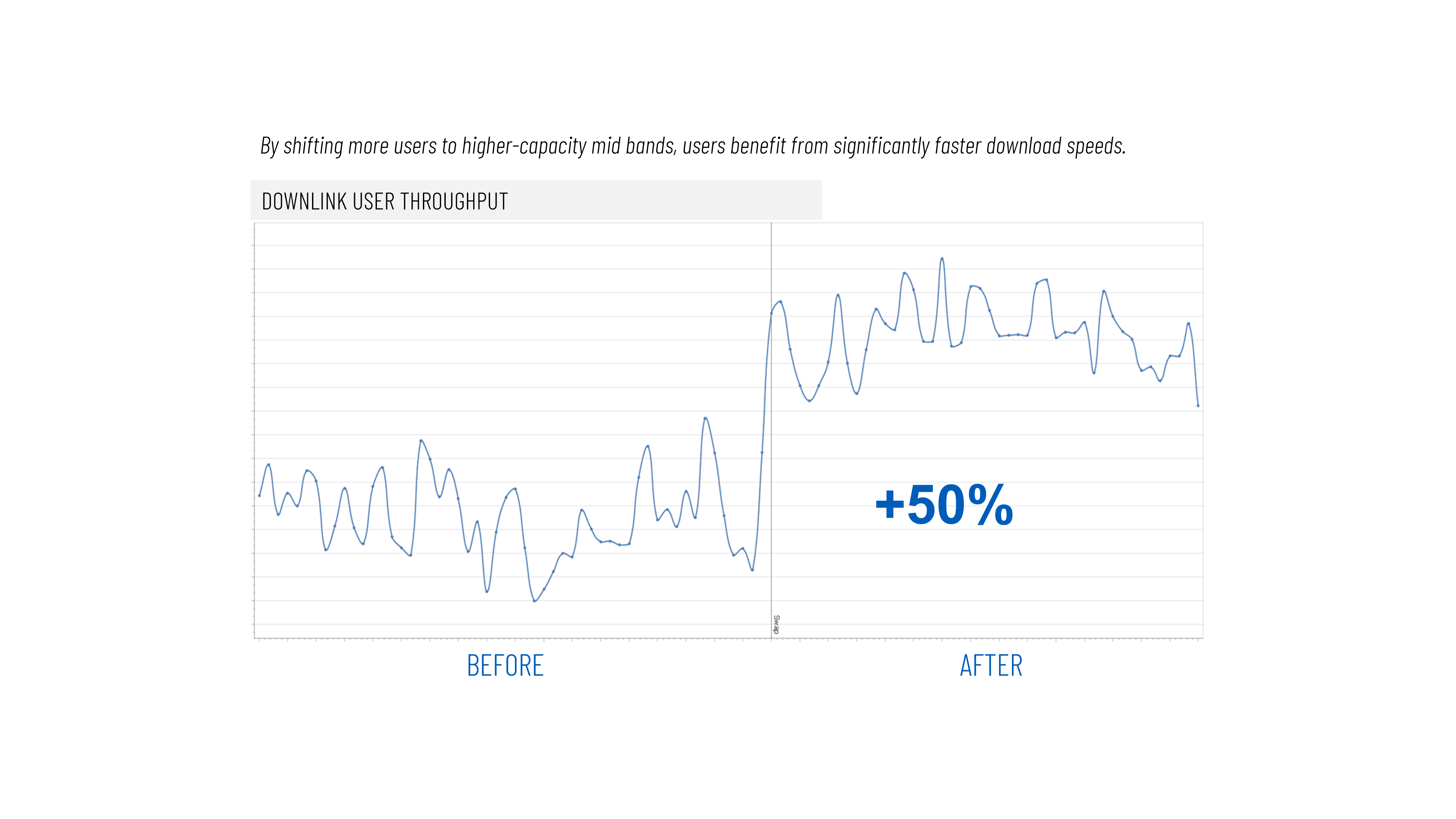
After modernizing legacy passive antennas with antennas incorporating ANDREW's SEED Gen 3 technology, the operator achieved a nearly 50% increase in downlink user throughput while reducing average downlink Physical Resource Block (PRB) utilization by 11%.
Importantly, these results were measured in a live commercial network under the same overall site traffic volume before and after modernization, providing a clear view of the impact on network performance and efficiency attributable to the antenna upgrade.
From antenna performance to network-level gains
Replacing a legacy passive antenna may appear to be a relatively simple hardware upgrade. However, the impact can extend far beyond the antenna itself.
Antennas designed with SEED Gen 3 technology combine improved antenna gain and efficiency with enhanced 3D radiation patterns. This helps make higher-capacity bands more accessible to users, creating an opportunity to rebalance traffic across the available spectrum and make better use of existing network capacity.
That is exactly what was observed in the deployment.
Traffic moved toward higher-capacity bands
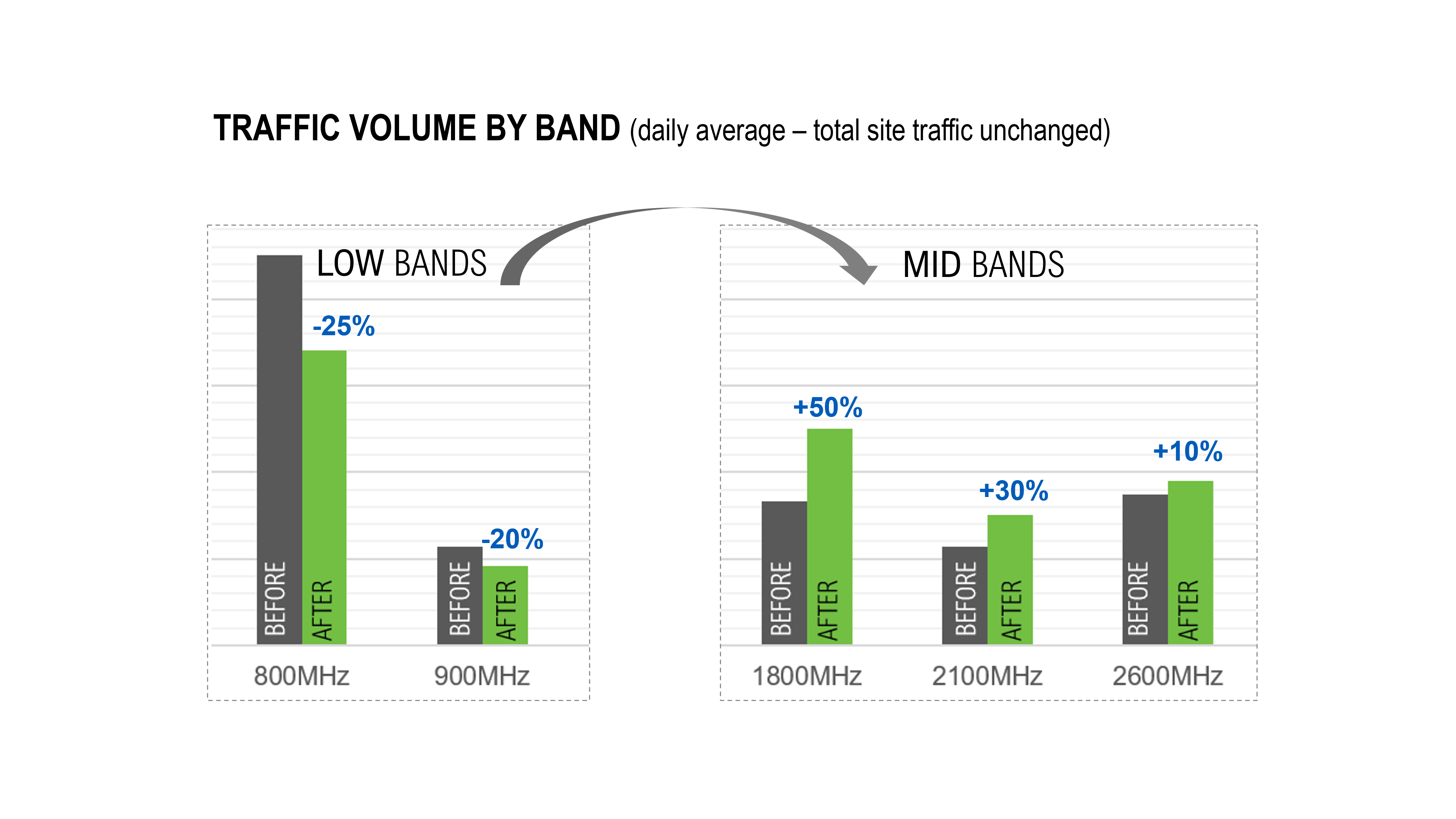
Following the modernization, traffic was distributed more effectively across the available frequency bands.
Traffic carried on the higher-capacity 1800 MHz, 2100 MHz and 2600 MHz bands increased by 50%, 30% and 10%, respectively, while load on the 800 MHz and 900 MHz bands decreased by 25% and 20%, respectively.
In other words, the network was able to make greater use of its mid-band spectrum, where operators typically have more bandwidth and can support higher MIMO schemes. This reduced the pressure on low-bands and improved utilization of the capacity already available across the site.
The result, enabled by SEED Gen 3 technology, was a more balanced traffic distribution across frequency bands.
Higher throughput across the network
The shift in traffic distribution was accompanied by a significant improvement in user experience.
As more users and traffic moved onto higher-capacity mid bands, downlink user throughput increased by nearly 50%.
For operators, this represents a significant improvement in the performance experienced by users, achieved without changes to the existing radio equipment or site footprint.
Better spectral efficiency means more from every PRB
Another important outcome was an 11% reduction in average downlink PRB utilization.
This indicates that the network was able to carry the same traffic volume more efficiently, freeing capacity to accommodate future traffic growth.
ANDREW's advanced antenna design methodology combines improvements in radiation efficiency with 3D performance metrics and network simulations to optimize both coverage and capacity, helping ensure that antenna innovation translates into measurable real-world network benefits.
This deployment provides a real-world example of that principle in action:
- better antenna performance
- better band utilization
- higher user throughput
- more efficient use of radio resources.
Modernizing the installed base of passive antennas
Operators have already invested heavily in sites, radios, power systems and transmission infrastructure. Replacing legacy antennas with higher-performance designs can help unlock additional value from those existing assets.
Passive antennas installed years ago do not have to define the performance of the network today.
Modernizing the installed base provides operators with another way to address growing traffic demand: improving the performance of existing sites before investing in new sites, additional spectrum, or more RAN infrastructure.
This European deployment demonstrates that for operators looking to increase network capacity and improve user experience, modernizing legacy antennas with high-efficiency technologies such as SEED Gen 3 can be a practical and cost-effective option. Often, the next step in network evolution is not adding more sites. It's getting more from the sites already in service.
To learn more about SEED® Gen 3 technology, download the white paper to discover how advanced 3D modeling and spatial efficiency metrics are redefining antenna performance, or watch the video to learn more about the concepts behind these results.
Author

Pedro Torres Martos
CTO, Europe
As CTO Europe, Pedro works closely with customers, partners, and industry stakeholders to shape technology strategy and address the evolving challenges of next-generation wireless networks, drawing on more than 25 years of experience in telecommunications.